
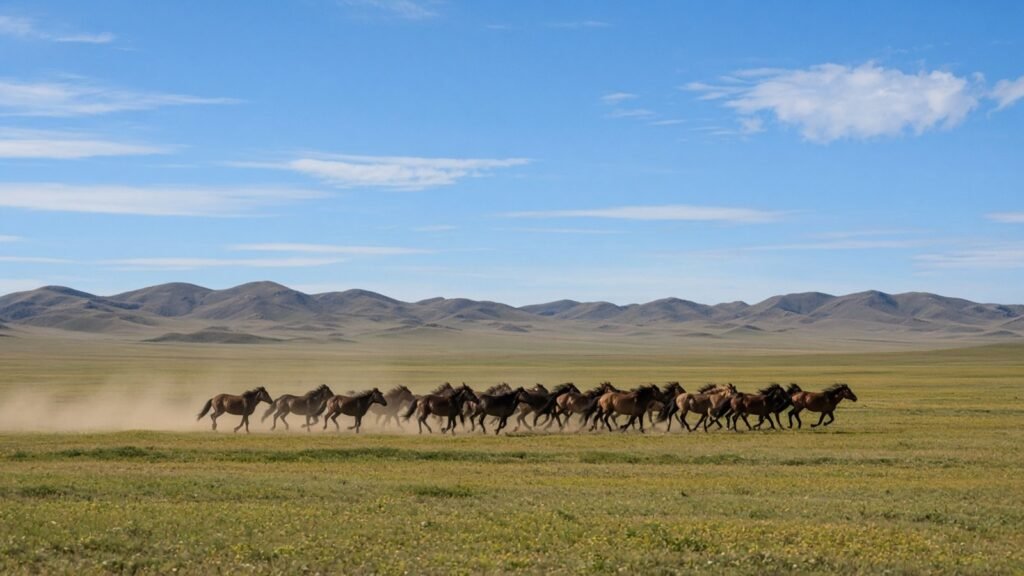
Mongolian culture grew out of life on the open steppe. Families moved with their herds, horses carried people across great distances, and homes were built to be packed up and moved. Many of those traditions are still very much alive, from a summer festival watched by the whole country to the round felt home that dots the countryside.
In short: three things make a good introduction to Mongolian culture. Naadam is the national summer festival of wrestling, horse racing and archery. Nomadic herding follows the seasons. The ger is the portable felt home at the centre of family life. UNESCO lists both Naadam and the craft of the Mongol ger as intangible cultural heritage.
Contents
Naadam: the festival of the three games
Naadam is Mongolia’s biggest festival. The national celebration is held every year from 11 to 13 July, and smaller local naadams take place in towns and districts across the summer. Naadam is also celebrated in Inner Mongolia and in Tuva in Russia. In 2010 it was added to UNESCO’s Representative List of the Intangible Cultural Heritage of Humanity.
The festival is often called the “three games of men”, but today women and girls take part in archery, and children are central to the horse races. UNESCO describes it as open to everyone, with music, food, crafts and traditional clothing all part of the celebration.
Wrestling
Mongolian wrestling, or bökh, is the best-known of the three games. Traditionally there are no weight classes. A bout ends when one wrestler touches the ground with a knee, elbow, back or other part of the upper body. Wrestlers wear a traditional open-chested jacket, briefs and boots, and after a win they often perform a slow eagle dance. Top wrestlers earn honorary titles, such as Lion and Giant, that stay with them for life.
Horse racing
Naadam horse races are not run on a track. They cross open country over long distances, and the length depends on the age of the horses. The riders are young and light, and the horses are the true stars. Winning horses are praised in songs and poems, and people gather at the finish to see them come in. The horse holds a deep place in Mongolian life, and these races show it more clearly than almost anything else.
Archery
Mongolian archers use traditional composite bows and shoot at rows of small targets set on the ground. Men and women both compete, and judges traditionally raise their arms and sing out the result of each shot. It is a calm, precise event and a lovely contrast to the excitement of the races.
More than sport
UNESCO notes that long song, khöömei throat singing, the morin khuur horse-head fiddle and traditional dance all appear during Naadam. Families gather, share food and greet people they may only see once a year. For many people, the meeting itself is as important as the games.
Nomadic life: moving with the seasons
Mongolian herding is built around five kinds of livestock: horses, cattle (including yaks), sheep, goats and camels. To keep animals healthy and the grass from being overgrazed, many herding families move camp several times a year, between summer pastures and sheltered winter sites.
Daily life follows the needs of the herd. There is milking, making dairy foods, watching the animals and preparing for the next move. Summer is the season of fresh dairy, such as yogurt, dried curds and airag, a lightly fermented mare’s milk. Winter is about staying warm and keeping animals safe through the cold.
Today Mongolia is a modern country with busy cities, and many Mongols live urban lives. Even so, herding is still practised across the countryside, and nomadic values such as hospitality, respect for nature and closeness to animals remain part of the culture.
The ger: a home built to move
The ger is the round, portable felt home of Mongolian herders. In English it is often called a yurt. In 2013 UNESCO added the traditional craftsmanship of the Mongol ger and its customs to its intangible heritage list.
How a ger is built
A ger has a few main parts, and each has a name:
- Khana: folding wooden lattice walls that open out into a circle.
- Uni: long roof poles that run from the walls to the centre.
- Toono: the round wooden crown at the top, which lets in light and lets out smoke from the stove.
- Bagana: two central posts that support the crown.
- Felt and canvas: layers of sheep’s-wool felt for warmth, covered in white canvas and tied down with ropes.
A family can take a ger down, load it and put it up again in a few hours. UNESCO notes that building and moving a ger is a family job, and children learn by watching their elders. Doors and woodwork are often painted with traditional patterns.
Inside the circle
A ger has its own customs. The door traditionally faces south, toward the sun. The place opposite the door, at the back, is the most honoured spot and is where guests of honour are seated. Visitors are expected not to step on the threshold and to move clockwise inside. Light from the toono travels around the walls during the day, and people once used it as a kind of sundial.
How this culture shapes our designs
Naadam, nomadic life and the ger give us many ideas: the shape of the toono, the lines of a running horse, the circle of the ger seen from above. We use them as inspiration for clean graphic designs that can be worn and used every day. We do not try to copy festival clothing or make costumes. Our aim is to honour the ideas behind these traditions in a simple, modern way.
Frequently asked questions
When is Naadam held?
The national Naadam festival is held from 11 to 13 July each year, with the main events in Ulaanbaatar. Local naadams are held at different times through the summer.
Is a ger the same as a yurt?
Ger is the Mongolian word. Yurt is the more common English term, and it is also used for similar homes in other parts of Central Asia.
Do people still live in gers today?
Yes. Many herding families in Mongolia live in gers, and gers are also common on the edges of cities, alongside apartment buildings and houses.
Carry a little of the steppe with you
If the rhythm of nomadic life speaks to you, explore our Nomad Life designs, with horses, gers and open land, or browse everything in the shop.
Explore the collection
Apparel, home goods and gifts inspired by Mongolian culture.